Celebrating the Quincentenary of the 1526 Worms New Testament
An interactive digital exhibition of the 280-page historical, textual, linguistic, and theological research volume presented by Bryan C. Ross, David W. Reid, and Alex Bojko. Explore how one linguistic genius, armed with Erasmus’s Greek New Testament and the Hebrew Scriptures, defied an empire, gave the English Bible its voice, and laid the direct foundation for the 1611 King James Bible.
“I call God to record, against the day we shall appear before our Lord Jesus to give a reckoning of our doings, that I never altered one syllable of God’s word against my conscience, nor would do this day, if all that is in the earth, whether it be honour, pleasure, or riches might be given me.” — William Tyndale to John Frith (1533) • Lesson 6, Doc p. 196
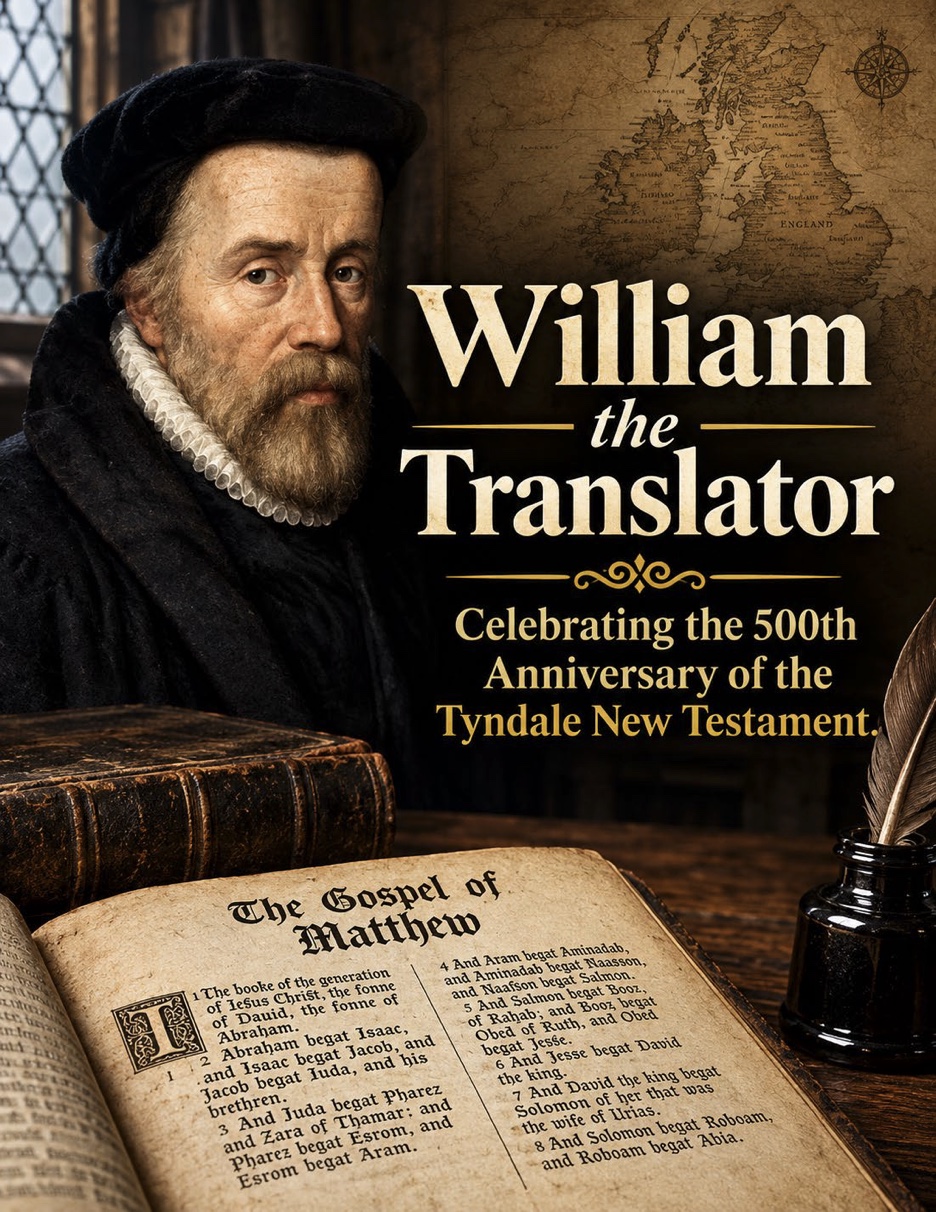
Click any lesson below to jump directly to that speaker’s research and primary-source documentation.
Situates Tyndale within the thousand-year continuum of the English language and Anglo-Saxon/Wycliffite Bibles, traces the Renaissance recovery of Greek through Erasmus, analyzes the 1526 Worms New Testament and Tyndale’s lexical choices, and proves how Tyndale’s work served as the direct rough draft of the 1611 King James Bible.
Investigates the thwarted 1525 Cologne quarto printing and its Textus Receptus alignment, dismantles modern dynamic-equivalence misuses of Tyndale’s “ploughboy” quote, and reconstructs the high-stakes Tudor political intrigue surrounding Tyndale’s betrayal, martyrdom, and literary legacy (“No Tyndale, No Shakespeare”).
Demonstrates that John Wycliffe, William Langland’s Piers Plowman, and native English Lollardy shaped Tyndale far more than German Lutheranism; examines Tyndale’s 1530 Hebrew Pentateuch and Old Testament translations; and evaluates Tyndale’s bibliology, bilateral covenant theology, and Augustinianism.
Click any city on the interactive exile map or filter the timeline by historical era to trace the 1,250-year journey from Ulfilas’s Gothic Gospels (AD 360) to the 1611 King James Bible.
Filter by speaker, theme, or keyword to inspect every chapter of the 280-page conference book. Click any card to view its full thesis, key evidence, and primary historical quotes.
Watch each recorded session alongside the written studies. Choose a video, then select “Load YouTube player” to consent to loading it here. Closing the player stops playback; each selection asks again. Appendices are included in the notes, not separate recordings. Video links open on YouTube if JavaScript is unavailable.
Explore the controversial Greek & Hebrew word battles that enraged Sir Thomas More, compare 1,250 years of parallel English Scripture, examine the Ploughboy vs. Modern Paraphrase evidence, and click through Tyndale’s immortal English coinages.
In John Foxe’s 1563 Actes and Monuments, Tyndale famously tells a learned Gloucestershire clergyman: “If God spare my life, ere many years I will cause a boy that driveth the plough, shall know more of the Scripture than thou doest.”
David Reid demonstrates that: (1) the ploughman metaphor came directly from Erasmus’s 1516 Paraclesis (borrowed from Jerome), (2) Tyndale’s point was freeing common people from Latin clerical ignorance—not replacing accurate biblical terms with crude slang, and (3) Tyndale actively wrote glossaries (“A Table Expounding Certain Words” in his 1530 Pentateuch) so readers would learn elevated theological vocabulary!
Modern dynamic-equivalence advocates and publishers—most notably Tyndale House Publishers (publisher of The Living Bible and New Living Translation)—have appropriated Tyndale’s name while violating his core translation ethic:
“Tyndale’s gift to the English language is unmeasurable. He translated into a register just above common speech, allied in its clarity to proverbs... The governing principle of these statements is accuracy.” — David Daniell & Leland Ryken (Doc p. 281)
| Reference | William Tyndale (1526 / 1537 Matthew's) | King James Bible (1611) | The Living Bible (TLB) / New Living Translation (NLT) |
|---|
The Puzzle: Erasmus’s Greek column included eikē (“without a cause”), backed by the vast majority of Greek MSS, the Syriac Peshitta, Gothic, and Anglo-Saxon Gospels. Yet Tyndale omitted “without a cause” in 1525/1526.
The Discovery: Bojko & Ross show that Tyndale was influenced by Erasmus’s Latin Annotations (which echoed Jerome’s ascetic suspicion of the word) and Martin Luther’s 1522 German NT, which also omitted it. Later English revisers—Coverdale (1535), Great Bible (1539), Geneva (1560), Bishops’ (1568), and the 1611 KJB—rightly restored “without a cause” in fidelity to the Greek Textus Receptus.
1526 Worms NT Proof: While Erasmus omitted the heavenly witnesses in 1516 and 1519, he restored 1 John 5:7 in his 1522 Third Edition based on Codex Montfortianus.
Decisive Evidence: Martin Luther omitted 1 John 5:7 in his 1522 German New Testament. William Tyndale, however, included 1 John 5:7 seamlessly in his 1526 Worms New Testament without brackets or small type—proving beyond doubt that Tyndale translated directly from Erasmus’s 1522 Greek text rather than copying Luther!
Pre-Norman Witness: Comparing extant Anglo-Saxon Gospels against 10 Gospel verses omitted by modern Critical Texts reveals that the Anglo-Saxon Gospels contain 8 of the 10 verses in full (Matt 12:21, 18:11; Mark 7:16, 9:44, 9:46, 15:28; Luke 17:36; John 5:4) plus Mark 16:9–20 and John 7:53–8:11.
1525 Cologne Fragment: Similarly, Tyndale’s 1525 Cologne Fragment includes Matt 12:47, 16:2–3, 17:21, 18:11, and 20:16b (“for many are called, and few be chosen”).
Both Catholic opponents (like Cochlaeus and Sir Thomas More) and many modern historians labeled Tyndale merely “Luther’s English echo.” Alex Bojko’s analysis of Tyndale’s upbringing, tracts, and prologues reveals a very different picture.
“The King James Bible stands as the crown of the English Bible tradition, but Tyndale remains its indispensable foundation.” (Bryan C. Ross, Doc p. 267)
When Tyndale was arrested in Antwerp on May 21, 1535, his associate John Rogers rescued Tyndale’s unpublished Old Testament manuscripts (Joshua through 2 Chronicles). In 1537—less than a year after Tyndale was strangled and burned at Vilvoorde on October 6, 1536—Rogers combined Tyndale’s 1534/1535 New Testament, 1530 Pentateuch, and Joshua–2 Chronicles with Miles Coverdale’s remaining OT books under the pseudonym “Thomas Matthew.” King Henry VIII officially licensed it for reading across England!
Three generations before Shakespeare and the 1611 translators, when English was dismissed by European scholars as “almost dead at the bottom of the pond,” Tyndale forged an oral, rhythmic style governed by accuracy, clarity, and Saxon vigor—giving English both its Reformation conscience and its literary golden age.